
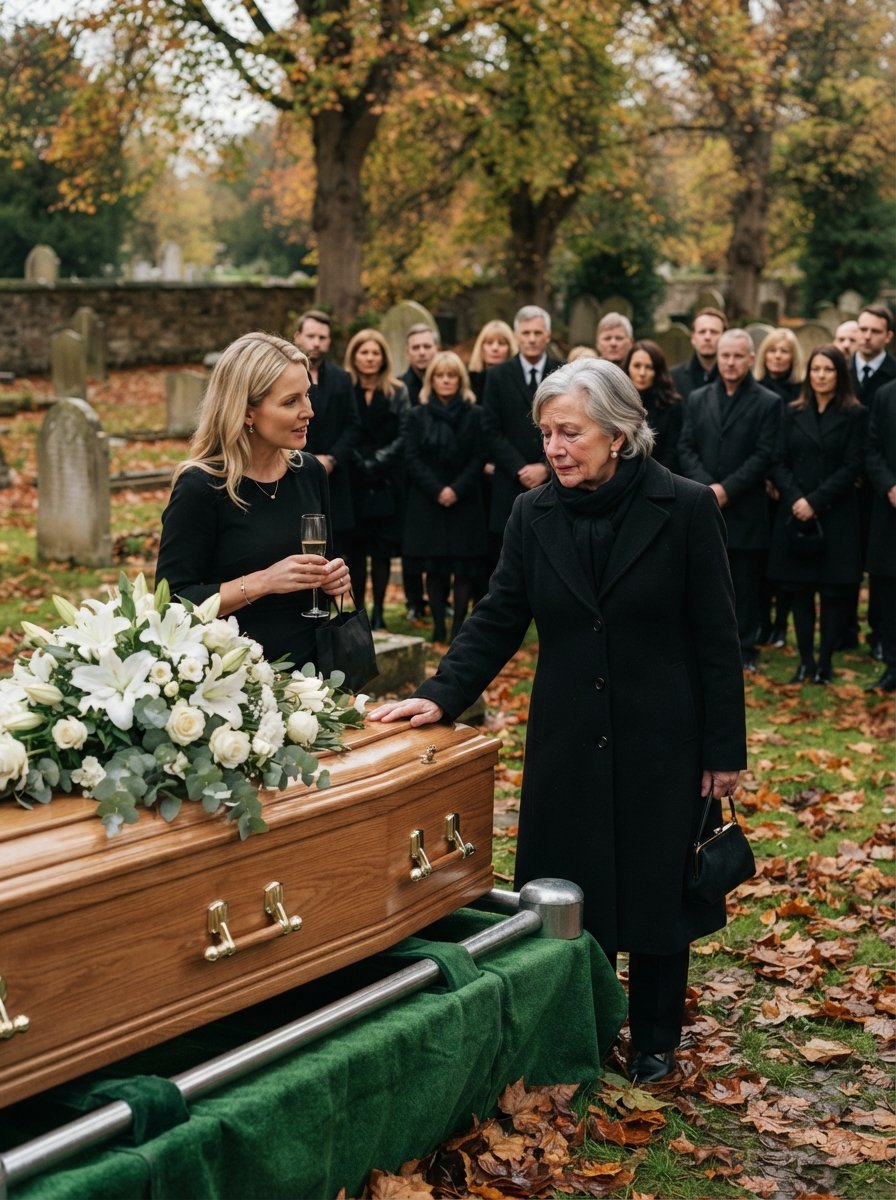
I buried my millionaire husband alone. My family was partying with loud music and champagne. My daughter-in-law texted me: “Stop being dramatic! This is urgent.” She meant my husband’s US 8 million inheritance… The shrew didn’t see this coming!
I buried my husband alone on a Tuesday morning in October while my own family threw a party in the parking lot of the funeral home. The sound of champagne glasses clinking reached my ears as I stood beside Harold’s casket, my hands trembling as I tried to hold myself together.
66 years old and this was how my life had come to this moment. The love of my life was gone and the people who should have been grieving with me were celebrating.
I could hear Addison’s voice above the others. My daughter-in-law’s laugh cutting through the crisp autumn air like a knife. She was telling someone about the vacation she was planning to take to Europe. Not next year, next month.
The funeral wasn’t even over, and she was already spending Harold’s money in her mind.
The pastor finished his prayer, his kind eyes meeting mine with genuine sympathy. He was probably the only person there who actually cared that Harold was gone.
Everyone else was just waiting for this inconvenient ceremony to end so they could get to the real business.
“Mrs. Patterson, I’m so sorry for your loss,” the pastor whispered, placing a gentle hand on my shoulder. Harold was a good man. He spoke of you often.
I nodded, unable to find my voice.
Harold had been more than good. He’d been everything to me for 38 years. We’d built a life together, a successful business, a family, or what I thought was a family.
As the small group of mourners began to disperse, I remained by the graveside. I wanted a few more minutes with him, just the two of us, before I had to face whatever was waiting for me.
But even that small comfort was denied.
Surely, come on, we need to talk.
Addison’s voice was sharp, impatient. She stood behind me, tapping her designer shoe against the ground.
Everything about her screamed money. The perfectly styled blonde hair. The expensive black dress that probably cost more than most people’s rent. The diamond earrings that caught the sunlight.
I turned slowly, my heart heavy.
Can’t this wait? I just buried my husband.
She rolled her eyes. Actually rolled her eyes at me.
Stop being so dramatic. Shirley Harold’s gone and now we have urgent matters to discuss. The lawyer is waiting.
Dramatic. She called me dramatic for wanting to grieve my husband.
I felt something cold settle in my chest, a numbness that had nothing to do with the October weather.
My son Michael stood beside her, looking uncomfortable, but saying nothing. He wouldn’t meet my eyes.
Behind them, I could see the rest of the family. My younger son David, his wife Sarah, even my grandchildren who were old enough to understand what was happening.
They all looked eager, excited even.
What’s so urgent that it can’t wait until tomorrow? I asked, though I already knew the answer.
Addison’s smile was all teeth. No warmth.
The $8 million. Surely, we need to discuss how Harold’s estate will be divided. The sooner we sort this out, the better for everyone.
$8 million.
That’s all they saw when they looked at Harold’s casket.
Not the man who’d worked 18-hour days to build his construction company from nothing. Not the husband who’d held my hand through every surgery, every loss, every difficult moment of our life together.
Just a number.
I haven’t even read the will yet, I said quietly.
Well, we have, David chimed in, speaking for the first time. Dad showed it to us last year. Everything gets divided equally among the family. You get your share and we get ours.
My heart sank.
Harold had shown them the will, but never discussed it with me. That didn’t sound like the man I’d been married to. But grief makes you doubt everything.
I need time to process this, I said, my voice barely above a whisper.
Addison stepped closer, her voice dropping to what she probably thought was a gentle tone, but sounded more like a threat.
Time is a luxury we don’t have, surely. There are taxes to consider, investments that need to be moved, properties that need to be managed. Harold always said you weren’t good with business matters.
That stung because it was partially true. Harold had handled most of our finances, saying he wanted to protect me from the stress of it all.
Now I was wondering if that protection had been a mistake.
Mom.
Michael finally spoke. But his voice lacked any real affection.
Addison’s right. The longer we wait, the more complicated things get. Dad would want us to handle this efficiently, would he?
I looked at my older son, trying to find some trace of the little boy who used to climb into my lap when he had nightmares.
But all I saw was a man who looked at me like I was an obstacle between him and his inheritance.
The ride home was silent.
I sat in the passenger seat of Michael’s car while Addison drove my own vehicle behind us. They didn’t trust me to drive myself home from my husband’s funeral.
The disrespect was breathtaking.
When we arrived at the house Harold and I had shared for over 20 years, it felt different, empty. Not just because Harold was gone, but because I could feel the vultures circling.
Addison immediately started walking through the rooms, pointing out expensive items to Michael.
The antique china set will need to be appraised, she said, running her finger along the dining room table. And these paintings are worth quite a bit.
I stood in the doorway of my own dining room watching strangers pick apart my life because that’s what they were.
Strangers.
I realized I didn’t really know these people at all.
My phone buzzed with a text message from Addison, even though she was standing right in front of me.
Stop being dramatic about everything. This is urgent business and Harold would want us to move quickly. The lawyer expects to see you tomorrow at 9:00 a.m. sharp. Don’t make this harder than it needs to be.
I stared at the message, reading it twice.
The woman was texting me while standing in my living room because she couldn’t be bothered to speak to me directly about my own husband’s estate.
That night, I sat alone in the bedroom Harold and I had shared, holding his pillow and trying to make sense of everything.
The family I thought I knew was gone, replaced by people who saw me as nothing more than an inconvenience standing between them and their payday.
But something Harold had said to me in his final weeks kept echoing in my mind.
He’d been so weak, so frail, but his eyes had been sharp and alert. He’d squeezed my hand and whispered, “Don’t worry, Shirley. I’ve made sure you’ll be taken care of. They can’t hurt you.”
At the time, I thought he was just trying to comfort me.
Now, as I faced the reality of my family’s greed, I wondered if Harold had seen something I hadn’t.
The lawyer’s office felt like a tribunal.
I sat across from Mr. Henderson, Harold’s attorney, for over 15 years, while my family arranged themselves around the conference table like they were preparing for battle.
Addison had positioned herself directly across from me. Her perfectly manicured hands folded on the mahogany table.
She’d brought a leather portfolio filled with what she called important documents, though I hadn’t been allowed to see what those were.
Michael sat beside her, checking his phone every few minutes. David and Sarah flanked them, completing the circle of expectation.
Mr. Henderson cleared his throat, his weathered face showing the strain of dealing with difficult families.
Mrs. Patterson, I know this is a difficult time, but there are some procedural matters we need to address regarding Harold’s estate.
Of course, I said quietly, my hands clasped tightly in my lap.
Now, the will that your family is referring to was indeed drafted last year, he continued, glancing briefly at Addison. However, there have been some developments.
Addison leaned forward eagerly.
What kind of developments? Harold told us the estate would be divided equally. 4.5 million for Shirley, and the rest split among the children and grandchildren.
I noticed she’d done the math down to the exact dollar. 4.5 million for me, 3.5 million for them.
In her mind, I was already getting too much.
Mr. Henderson looked uncomfortable.
Well, that’s what we need to discuss. Harold made some changes to his estate planning in his final weeks.
What kind of changes? Michael asked, his voice sharp.
I’m not at liberty to discuss all the details until the formal reading, which is scheduled for next week. But I can tell you that Harold was very specific about his wishes.
Addison’s smile faltered.
Specific how.
I think it’s best if we wait for the formal reading, Mr. Henderson said diplomatically.
The tension in the room was thick enough to cut. I could feel their frustration radiating across the table.
This wasn’t going according to their plan.
After we left the lawyer’s office, the family followed me home like a pack of wolves.
What happened next made me realize just how deep their greed ran.
Addison immediately pulled out her phone and started making calls. I could hear her talking to someone about complications and delays and how they needed to handle the situation quickly.
Meanwhile, Michael and David began walking through the house again, this time with a notebook, writing down everything they saw.
When I asked what they were doing, David looked at me like I was stupid.
“We’re cataloging assets, Mom. Someone needs to keep track of everything until the estate is settled.”
“This is my home,” I said, my voice shaking. “Harold and I built this life together.”
And now Harold’s gone, Addison said, not even looking up from her phone. We need to be practical about what happens next.
That evening, they didn’t leave.
Addison announced that she and Michael would be staying to help me through this difficult transition.
They moved into the guest room without asking, making themselves at home like they owned the place.
I retreated to my bedroom, but even there, I couldn’t find peace.
I could hear them talking downstairs, their voices carrying up through the vents.
She’s being unreasonable about this, Addison was saying. Harold always said she got too emotional about money matters. Maybe we should consider other options.
Michael replied, “I mean, if she’s not capable of handling this kind of responsibility, what are you suggesting?”
That was David’s voice.
“I’m just saying that grief can affect people’s judgment. Maybe she needs someone to help her make these important decisions.”
I felt my blood run cold.
They were discussing having me declared incompetent, taking away my right to make decisions about my own life, my own money, my own future.
The next morning, Addison was waiting for me in the kitchen with coffee and what she called a reasonable proposal.
“Surely, we’ve been thinking,” she said, her voice dripping with false sweetness. “This whole estate situation is going to be very complicated. Taxes, investments, legal matters.”
Harold always protected you from these stresses and we want to continue that protection.
I poured myself coffee with hands that trembled slightly.
What are you proposing?
We handle everything. Michael has his MBA. David understands business and I have experience with estate planning. You keep the house of course and a comfortable allowance for your needs. We manage the rest.
An allowance? I repeated.
Well, yes. Harold always said, “You were better at spending money than managing it.”
She laughed like it was a fond memory instead of an insult.
I thought about the woman Harold had fallen in love with 38 years ago.
I’d been 28, working as an office manager for a small company, handling budgets and payroll, and keeping everything running smoothly.
I wasn’t some helpless creature who needed protection from financial decisions.
“I want to wait for the will reading,” I said firmly.
Addison’s smile tightened.
“Of course, but surely. I hope you’ll consider what’s really best for everyone.”
Harold wouldn’t want his death to cause problems for the family.
That afternoon, while Addison and Michael were out running what they called estate errands, I found myself alone in Harold’s study.
I’d avoided this room since his death, but something drew me there.
His desk was exactly as he’d left it. His coffee mug still stained from his last cup. His reading glasses folded neatly beside a stack of business magazines.
And there, tucked under his desk bladder, I found something that made my heart stop.
A business card for a different lawyer, someone I’d never heard of.
On the back in Harold’s handwriting, were the words for surely only tell no one.
I stared at that card for a long time, my mind racing.
Why would Harold need a second lawyer? Why the secrecy? And why leave this where only I would find it?
When Addison and Michael returned that evening, they were in high spirits.
They’d apparently spent the day meeting with financial adviserss and real estate agents, making plans for money they didn’t even have yet.
“We found the most wonderful investment opportunities,” Addison gushed over dinner. “There’s a development project that could triple our returns in just 2 years.”
Our returns?
She was already spending Harold’s money, already assuming it was hers to invest.
And we looked at some properties, Michael added. This house is beautiful, Mom, but it’s really too big for just you. We found some lovely condominiums that would be much more manageable.
They wanted to sell my home.
The place where Harold and I had been happy, where we’d raised our children, where every room held memories of our life together.
To them, it was just another asset to be liquidated.
That night, after they’d gone to bed, I sat in Harold’s study holding that business card.
Whatever he’d been planning, whatever he’d seen that I missed, he’d left me a clue.
The card was for a lawyer named Rebecca Morrison. Her office was across town, far from Mr. Henderson’s firm.
I turned the card over again, reading Harold’s message.
For surely only tell no one.
I had a choice to make.
I could go along with my family’s plans, let them manage everything, live quietly on whatever allowance they deemed appropriate, or I could find out what Harold had really wanted, what he’d been trying to protect me from.
As I sat there in the darkness, listening to the sounds of Addison and Michael moving around upstairs in what they clearly considered their temporary home, I made my decision.
Tomorrow I would call Rebecca Morrison.
Whatever Harold had set in motion, whatever protection he’d tried to give me, I was going to find out what it was because something told me that the real battle was just beginning.
I waited until Addison and Michael left for what they called their estate planning meeting before I made the call.
My hands shook as I dialed the number on Rebecca Morrison’s business card, and I nearly hung up twice before she answered.
Morrison law office. This is Rebecca.
My name is Shirley Patterson, I said quietly, glancing toward the window to make sure they weren’t coming back.
I found your card in my late husband’s desk. Harold Patterson.
There was a pause.
Then her voice became gentle but urgent.
Mrs. Patterson, I’ve been expecting your call. Can you come to my office today? And please don’t tell anyone about this conversation.
The drive across town felt like the longest 20 minutes of my life.
I kept checking my rear view mirror, paranoid that somehow Addison would appear behind me.
Rebecca Morrison’s office was in a small professional building, nothing like the imposing downtown firm where Mr. Henderson worked.
Rebecca herself was younger than I’d expected, probably in her early 40s, with kind eyes and a nononsense demeanor.
She led me into her office and immediately closed the door.
Mrs. Patterson, please sit down. I have some very important things to discuss with you about your husband’s estate.
My heart was pounding.
I don’t understand. Harold’s will is being read next week by Mr. Henderson. Why would he need another lawyer?
Rebecca opened a file cabinet and pulled out a thick folder marked Patterson confidential because 3 weeks before he died, Harold came to me to create a new will.
He specifically asked me to keep it completely secret until after his death.
I felt the room spinning slightly.
A new will.
But the family said Harold showed them his will last year.
He did. That will is real, but it’s no longer valid.
Rebecca opened the folder and pulled out a document.
This is Harold’s final will and testament dated just 18 days before he passed away. It supersedes all previous versions.
I stared at the papers in her hands, afraid to hope, afraid to believe.
Why would he do this in secret?
Rebecca’s expression grew serious.
Harold told me he’d been watching his family’s behavior during his illness. He said he was horrified by what he saw.
They weren’t visiting to spend time with him. They were calculating their inheritance.
He overheard conversations about spending his money before he was even gone.
My chest tightened.
I remembered Harold’s final weeks, how exhausted he’d been, but how alert his eyes remained, how he’d watched everyone who came to visit.
I’d thought he was just studying faces, trying to memorize them, but he’d been evaluating character.
“What does the new will say,” I whispered.
Rebecca handed me the document.
“Perhaps you should read it yourself.”
My hands trembled as I took the papers.
The legal language was complex, but certain phrases jumped out at me immediately. I had to read them twice to believe what I was seeing.
To my beloved wife, Shirley, who has stood by me through every challenge, and loved me unconditionally, I leave the entirety of my estate, including all properties, investments, and liquid assets, totaling approximately $8 million.
I looked up at Rebecca, speechless.
Keep reading, she said gently.
To my sons, Michael and David, and to my daughter-in-law, Addison, who have shown during my final illness that they value my money more than my life.
I leave the sum of $1,000 each, with the hope that they will learn the difference between love and greed.
The papers fell from my hands.
$8 million.
Harold had left me everything.
Everything.
But there’s more, Rebecca said, retrieving the papers.
Harold also left you a letter. He insisted I give it to you personally when we met.
She handed me an envelope with my name written in Harold’s familiar handwriting.
I opened it with shaking fingers.
My dearest Shirley, the letter began.
If you’re reading this, then you found your way to Rebecca, and I’m no longer there to protect you myself.
I need you to know that the decision to change my will was not made lightly or in anger, but from a place of profound sadness about what our family has become.
During my final weeks, I watched our children in Addison carefully. I listened to their conversations when they thought I was sleeping.
I heard them discussing how they would divide my money, what they would buy, where they would travel.
Not once did I hear them express genuine sadness about losing me as a father or husband.
Addison went so far as to tell Michael that they should encourage you to move into a smaller place so they could sell the house quickly.
David suggested that you might not be mentally capable of handling large sums of money and that they should manage everything for you.
Surely you are the strongest, most capable woman I’ve ever known.
You managed our household finances for years before I took over. And you did it brilliantly.
You raised our children with love and patience, even when they disappointed us.
You deserve so much more than they were planning to give you.
I’ve left you everything because you’re the only one who loved me for who I was, not for what I could provide.
Use this money to live the life you deserve. Travel to all those places we talked about visiting. Buy yourself beautiful things.
Most importantly, don’t let them manipulate you into feeling guilty about my decision.
I love you always, Harold.
By the time I finished reading, tears were streaming down my face.
Rebecca handed me a box of tissues and waited patiently while I composed myself.
Harold was very specific about the timing, she said finally. He wanted you to have a few days to process this information before the family finds out.
He also included instructions about how to handle their reaction.
What kind of instructions?
Rebecca pulled out another document.
He anticipated that they would contest the will, claim undue influence, or try to have you declared mentally incompetent.
So, he took steps to protect you.
She showed me a medical evaluation dated 2 weeks before Harold’s death.
He had himself examined by a geriatric psychiatrist to establish that he was of sound mind when he made these changes.
He also had our meetings videotaped, showing clearly that he was making these decisions freely and without any pressure from you.
I looked at the evaluation.
Doctor Sarah Chen had conducted extensive cognitive tests and declared Harold mentally sharp and fully capable of making complex decisions about his estate.
There’s also this, Rebecca said, handing me a small recording device.
Harold asked me to give this to you. He said it would help you understand why he felt he had to take such drastic action.
I held the device, almost afraid to press play.
Go ahead, Rebecca encouraged. Harold wanted you to hear this.
I pressed the button and Harold’s voice filled the room, weak but determined.
Surely, if you’re hearing this, then Rebecca has done as I asked.
I need you to know that changing my will was the hardest decision I’ve ever made because it means accepting that our children have become people we didn’t raise them to be.
But I couldn’t let them treat you the way they’ve been treating you.
I’ve watched Addison roll her eyes when you speak. I’ve seen Michael brush off your opinions like you’re a child. I’ve heard David talking about you like you’re a burden they’ll have to manage.
You deserve better than that.
You deserve to be treated with the respect and love you’ve earned through 38 years of being the most wonderful wife and mother anyone could ask for.
Don’t let them make you feel guilty about this decision.
It was mine to make. And I made it with a clear mind and a heavy heart.
Live well, my darling.
Be happy and remember that everything I’m giving you, you already earned just by being you.
When the recording ended, the office was quiet except for the sound of my crying.
But these weren’t tears of sadness anymore.
They were tears of relief, of gratitude, of overwhelming love for a man who had protected me even from beyond the grave.
“When will they find out?” I asked finally.
“The official will reading is scheduled for Monday morning at Henderson’s office. I’ll be there to present the new will and explain its validity. Are you prepared for their reaction?”
I thought about Addison’s texts. Michael’s dismissive attitude, David’s assumption that I couldn’t handle my own affairs.
I thought about them cataloging my possessions like auctioneers, planning to sell my home, discussing my mental capacity.
Yes, I said, surprised by the strength in my own voice. I’m ready.
Rebecca smiled.
Harold said you would be.
He also left instructions for me to help you with anything you need. Changing locks, updating bank accounts, finding security if necessary.
He thought of everything.
As I drove home, Harold’s letter tucked safely in my purse, I felt something I hadn’t experienced in weeks.
Hope.
For the first time since Harold’s death, I wasn’t afraid of what was coming.
I had one more weekend to prepare myself for the moment when my family would learn that their plans had been built on a foundation of sand.
Monday morning arrived gray and drizzling, matching the mood in Mr. Henderson’s conference room.
The family had assembled like shareholders at a board meeting, each of them dressed in their finest clothes, barely containing their excitement about finally getting their hands on Harold’s money.
Addison sat across from me wearing a black designer suit that probably cost more than most people made in a month.
She’d had her hair done specially for the occasion and kept checking her diamond watch.
Michael and David flanked her, both in expensive suits, looking like they were attending a business merger rather than their father’s will reading.
Even the grandchildren were there.
My grandson Tyler, 22, and already showing signs of the family’s entitlement, and my granddaughter, Emma, 19, and more interested in her phone than the proceedings.
They’d been promised college money and new cars from Grandpa’s inheritance.
Mister Henderson looked uncomfortable as he shuffled through his papers.
I noticed he kept glancing toward the door as if he was waiting for someone.
“Before we begin,” he said carefully. “I need to inform everyone that there has been a development regarding Harold’s estate.”
Addison leaned forward eagerly.
“What kind of development? Has the value increased?”
“Not exactly.”
Mr. Henderson cleared his throat.
It appears that Harold created a more recent will that supersedes the document we were planning to read today.
The temperature in the room seemed to drop 10°.
Michael spoke first, his voice sharp.
What do you mean more recent? Dad showed us his will last year. Everything was settled.
I’m afraid estate planning can be fluid. People do sometimes make changes, especially as they face end of life circumstances.
David slammed his hand on the table.
This is ridiculous. Dad was barely conscious his last few weeks. Someone obviously took advantage of him.
They all turned to look at me.
The accusation hung in the air like smoke.
I had nothing to do with any changes, I said quietly, though my heart was racing.
Addison’s eyes narrowed.
Of course you’d say that. You’ve been alone with him for months while he was sick. Who knows what kind of pressure you put on him?
At that moment, the conference room door opened and Rebecca Morrison walked in carrying her own briefcase.
The family looked confused. They’d never seen her before.
“Good morning,” Rebecca said professionally. “I’m Rebecca Morrison and I represent the Patterson estate regarding Harold’s final will and testament.”
Mister Henderson looked relieved to have backup.
Ms. Morrison has brought the most recent version of Harold’s will dated 3 weeks before his death.
This is insane, Michael said, standing up. We don’t recognize any other lawyer. Henderson has been Dad’s attorney for 15 years.
Rebecca remained calm.
Mr. Patterson was certainly free to seek additional legal counsel, which he did.
I have all the proper documentation here, including medical evaluations confirming his mental competency at the time of signing.
She placed a thick folder on the table and opened it with deliberate precision.
Before I read the will, I want everyone to understand that Harold Patterson was of completely sound mind when he made these decisions.
He was evaluated by Dr. Sarah Chen, a boardcertified geriatric psychiatrist, just 5 days before signing this document.
Addison’s face was turning red.
I don’t care what some quack doctor says. Harold was dying. People don’t think clearly when they’re dying.
On the contrary, Rebecca replied smoothly.
People often think more clearly about what truly matters when they’re facing mortality. Harold certainly did.
She picked up the will and began to read in a clear, professional voice.
I, Harold William Patterson, being of sound mind and body, do hereby revoke all previous wills and testaments, and declare this to be my final will.”
The legal language went on for several paragraphs, but I could see the family getting increasingly impatient.
Tyler was actually texting someone, probably already making plans for his inheritance money.
Then Rebecca reached the crucial section.
To my beloved wife, Shirley Patterson, who has been my faithful companion for 38 years, and who has shown me unconditional love through health and sickness, I leave the entirety of my estate, including all real property, investment accounts, business interests, and personal possessions, totaling approximately $8 million.
The silence that followed was deafening.
I could hear the rain against the windows, the hum of the air conditioning, the sound of Emma dropping her phone.
“What?” Addison whispered.
Rebecca continued reading, her voice steady and clear.
“To my son Michael Patterson, to my son David Patterson, and to my daughter-in-law Addison Patterson, I leave the sum of $1,000 each.”
This modest bequest reflects my disappointment in their behavior during my final illness when they showed more interest in my financial assets than in my well-being.
Michael shot to his feet, his face purple with rage.
This is fraud. This is elder abuse. She manipulated him.
The will isn’t finished, Rebecca said calmly. There’s more.
She continued reading.
I am making this decision with full awareness of its implications.
During my final weeks, I observed my family’s true priorities.
I heard conversations about how quickly my assets could be liquidated, how my wife could be managed to ensure smooth financial transitions, and how my death would solve their various money problems.
These conversations broke my heart and opened my eyes.
My wife Shirley has never asked me for anything beyond my love and presence.
She has sacrificed her own desires countless times for our family’s benefit.
She deserves to live her remaining years in comfort and dignity, free from the financial manipulation I witnessed being planned for her future.
David was shaking his head frantically.
No, no, no. This isn’t happening. Dad wouldn’t do this. He loved us.
He did love you, I said softly, speaking for the first time since Rebecca began reading.
That’s why this hurt him so much.
Addison turned on me with venom in her eyes.
You conniving witch. You poisoned his mind against his own children. You’re not getting away with this.
Rebecca reached into her briefcase and pulled out a small video camera.
Actually, I think you’ll find that Mrs. Patterson had nothing to do with Harold’s decision.
Your father-in-law recorded several video statements explaining his reasoning. Would you like to see them?
The family exchanged glances, suddenly looking less certain.
Furthermore, Rebecca continued, Harold anticipated that there might be challenges to this will, so he took extensive precautions.
In addition to the psychiatric evaluation, he had all our meetings professionally recorded.
He also kept a detailed journal during his final month documenting the conversations and behaviors that led to his decision.
She pulled out a leatherbound notebook.
For instance, there’s an entry from October 3rd where he writes about overhearing Addison tell Michael that they should handle Shirley carefully so she wouldn’t cause problems with the estate division.
Another entry from October 7th describes David’s suggestion that Shirley might need a competency evaluation to ensure she could handle her inheritance responsibly.
Addison’s face went white.
Those were private conversations they’d thought no one could hear.
There’s also an entry about the family’s discussion of selling the family home quickly to maximize liquid assets, and another about plans to set up trust funds that would essentially put Shirley on an allowance from her own inheritance.
The room was deadly quiet.
Every damning conversation, every greedy plan, every dismissive comment about my capabilities had been recorded by my dying husband.
Tyler finally looked up from his phone, reality sinking in.
Wait, so we’re not getting anything? What about my college money? What about the car you promised me?
What?
You’re getting exactly what your grandfather thought you deserved, Rebecca said matterofactly.
$1,000 each.
Emma started crying. Not from grief, but from disappointment about the shopping spree she’d been planning.
Michael turned to me, his voice desperate now.
Mom, you can’t let this stand. We’re family. Dad was obviously not thinking clearly. You know, he wanted to take care of all of us.
He did take care of the person he felt deserved it, I replied, my voice stronger than I felt.
He took care of me.
Addison stood up abruptly, her chair scraping against the floor.
This isn’t over. We’ll contest this will. We’ll prove you manipulated a dying man. We’ll drag this through court for years if we have to.
Rebecca smiled coldly.
Actually, you won’t.
Harold included a no contest clause in the will.
Anyone who challenges it forfeits even their $1,000 bequest.
Additionally, he set aside $50,000 specifically to defend this will against any legal challenges.
He was quite thorough.
The family sat in stunned silence, finally understanding that Harold had anticipated every move they might make and blocked them all.
I suggest you take some time to process this information, Rebecca said, beginning to pack up her papers.
Mrs. Patterson, perhaps we should discuss the practical aspects of managing your inheritance.
As we prepared to leave, Addison made one last desperate attempt.
Surely, please think about what Harold would really want. Think about the grandchildren’s futures. Think about family.
I stopped at the door and turned back to face them all.
For 38 years, I’d been thinking about family, putting family first, sacrificing for family.
Now, it was time to think about what Harold had actually wanted for me to be free.
I am thinking about family, I said quietly.
I’m thinking about the family of two that Harold and I built together and how he wanted to protect me even after he was gone.
As I walked out of that conference room with Rebecca beside me, I felt Harold’s presence like a warm hand on my shoulder.
He’d given me more than money.
He’d given me vindication, protection, and most importantly, the freedom to live the rest of my life on my own terms.
The phone started ringing before I even got home from the lawyer’s office.
I let it go to voicemail, then another call, then another.
By the time Rebecca dropped me off at my house, I had 17 missed calls and 23 text messages.
I sat in my living room, the same room where just days ago my family had been cataloging my possessions like they already owned them, and listened to the voicemails.
The progression was fascinating in its predictability.
The first few were from Michael, his voice trying to sound reasonable.
Mom, we need to talk about this misunderstanding. Obviously, Dad wasn’t thinking clearly. We can work this out as a family.
Then, David.
This is insane, Mom. You know, Dad wanted to take care of all of us. Don’t let some lawyer manipulate you into thinking otherwise.
But as the day wore on, the messages became more desperate, more angry, more revealing of who they really were.
Addison’s voice was shrill with barely controlled fury.
You selfish witch. After everything this family has done for you, this is how you repay us. Harold would be ashamed of what you’ve become.
The irony wasn’t lost on me.
Harold had literally recorded his thoughts about their behavior, and somehow I was the problem.
The text messages were even worse.
Michael wrote, “You’re destroying this family over money. Is that really what you want your legacy to be?”
Sarah, David’s wife, chimed in.
The children are asking why grandma is being so mean to the family. How do I explain that their inheritance is gone because of your greed?
Tyler, my own grandson, sent, “Thanks for ruining my college plans, Grandma. Hope the money was worth losing your family.”
But it was Emma’s message that cut the deepest.
“I thought you loved us. I guess money matters more to you than your own grandchildren.”
I set the phone down and walked to Harold’s study.
Everything was exactly as he’d left it, and I found comfort in the familiar smell of his cologne and the sight of his reading glasses on the desk.
I opened the drawer where I’d found Rebecca’s business card and pulled out the journal Harold had mentioned.
It was a small leather notebook filled with his careful handwriting.
As I read through the entries from his final weeks, my heart broke all over again.
Not for the loss of my family’s love because I was beginning to understand I’d never really had it, but for Harold’s pain in discovering their true nature.
October 1st, one entry read, “Addison spent 40 minutes on the phone today discussing vacation plans for after. She was standing right outside my bedroom door. She didn’t even lower her voice. She’s already booked a cruise to Europe for next month.”
October 5th.
Michael brought a real estate agent’s card today. Said he was just getting prepared for when the house would need to be sold. He asked if I thought Shirley would be reasonable about moving somewhere smaller. The agent was waiting in the car.
October 12th.
Overheard David and Sarah arguing about whether to put the kids in private school immediately after the inheritance comes through or to wait until next year.
They were sitting at my kitchen table eating food Shirley had prepared for them. Making plans with money I haven’t even left them yet.
But the entry that destroyed me was from just 5 days before he died.
October 21st.
I told Shirley today that my chest was hurting more than usual.
She dropped everything, called the doctor, held my hand while we waited for him to call back.
When Addison heard about the chest pains, she asked if I’d updated my emergency contact information lately and whether Shirley had access to all the important account numbers.
She didn’t ask if I was okay.
She didn’t ask if I was scared.
She wanted to know about the accounts.
I closed the journal and sat in Harold’s chair, finally understanding the depth of his heartbreak.
He hadn’t just been leaving me money.
He’d been leaving me evidence that I wasn’t crazy, that I hadn’t imagined the coldness and calculation I’d been feeling from our family.
The doorbell rang, interrupting my thoughts.
Through the window, I could see Michael’s car in the driveway.
My heart began to race, but I stealed myself and opened the door.
They were all there, Michael, Addison, David, Sarah, even the grandchildren.
They looked like a delegation standing on my porch with serious expressions.
“We need to talk,” Michael said without preamble.
I let them in, watching as they filed into my living room like they were entering a courtroom.
Addison had clearly been crying, though whether from grief or frustration, I couldn’t tell.
The grandchildren looked uncomfortable, like they’d been dragged into an adult situation, they didn’t understand.
Mom, Michael began, his voice carefully controlled.
We’ve been talking and we think there’s been a terrible mistake.
What kind of mistake? I asked, settling into Harold’s favorite chair.
Dad wasn’t himself these last few weeks, David said. The pain medication, the stress of being sick. It obviously affected his judgment.
Addison leaned forward, her eyes red-rimmed but intense.
Surely you know Harold loved his children. You know he wanted to provide for his grandchildren’s futures. This will doesn’t reflect the man we knew.
Actually, I said quietly. I think it reflects exactly the man you knew.
You just didn’t know him as well as you thought you did.
Sarah spoke up, her voice thick with emotion.
The children are devastated. Tyler was counting on that college money. Emma had dreams of studying abroad. How can you look at them and tell them their grandfather didn’t love them enough to provide for their futures?
I looked at my grandchildren, seeing them clearly for perhaps the first time.
Tyler was texting, not even paying attention to the conversation about his supposedly devastated future.
Emma was scrolling through social media, occasionally sighing dramatically for effect.
Harold left detailed instructions about college funds.
I said, “Did you know that?”
He set aside money specifically for their education in accounts that you couldn’t touch.
The money is still there waiting for them when they’re ready for college.
The room went silent.
This was clearly news to them.
But, I continued, “The accounts have conditions.”
The children have to maintain good grades, stay out of trouble, and show respect for their family members, including me.
Tyler finally looked up from his phone.
What kind of conditions?
The kind that require you to earn what you’re given instead of just expecting it to be handed to you.
Addison’s facade finally cracked.
This is ridiculous. You’re talking about a 22year-old like he’s a child.
I’m talking about a 22-year-old who just sent me a text calling me selfish for ruining his college plans when his college fund has been sitting untouched in an account for 4 years.
Tyler graduated college last year with honors on scholarship.
The money Harold saved for his education was never needed.
Everyone turned to look at Tyler who had the grace to look embarrassed.
“I thought maybe I could use it for graduate school,” he mumbled.
And Emma, I continued, Harold set aside $15,000 for your study abroad program.
The same program you decided not to do because you didn’t want to miss a semester of sorority parties.
Emma’s mouth fell open.
How did you know about that?
Because Harold told me everything.
He was proud when you got accepted to the program and disappointed when you changed your mind.
The money is still there if you decide you want to experience the world instead of just Instagram posts about it.
The family exchanged glances, realizing that their narrative of a grandfather who didn’t provide for his grandchildren was falling apart.
Michael tried a different approach.
Okay, so Dad made provisions for the kids. That’s good.
But mom, you have to understand. We’re not talking about wanting luxuries.
David’s business is struggling. I’ve got a mortgage and two car payments.
We counted on this inheritance to get our lives back on track.
You counted on your father’s death to solve your financial problems, I said bluntly.
Do you understand how that sounds?
Addison stood up abruptly.
This is getting us nowhere.
Surely I’m going to ask you one more time to do the right thing.
Harold may have been angry about something when he changed that will, but you know what he really would have wanted?
Family takes care of family.
I looked around the room at these people who shared my blood, my history, my last name.
People I’d loved, worried about, sacrificed for, celebrated with, grieved with, people who had become strangers to me without my even noticing when it happened.
You’re right, I said finally.
Family should take care of family.
Harold took care of me. I took care of him.
We took care of both of you until you became adults capable of taking care of yourselves.
But you never learned that lesson, did you?
You kept expecting us to fix your problems, fund your dreams, bail you out of your mistakes.
I stood up, moving to the window where I could see the garden Harold and I had planted together.
Family doesn’t mean you’re entitled to someone else’s money just because you share their DNA.
Family means you love people for who they are, not for what they can give you.
When I turned back to face them, David was shaking his head.
So that’s it. You’re going to keep everything and leave your own children with nothing.
I’m going to honor your father’s wishes.
I said, “The same father who worked 18-hour days to build the business that created this wealth. The same father who scrimped and saved and invested wisely so that his family would be secure. The same father who watched his children plan his funeral around their inheritance checks.”
The silence that followed was broken by Emma’s quiet voice.
Is that really what grandpa thought about us?
I looked at my granddaughter, seeing something in her face that I hadn’t seen from the others.
Genuine remorse.
Your grandfather loved you all very much, I said gently.
But love doesn’t mean giving people everything they want.
Sometimes love means helping them learn to stand on their own feet.
As they filed out of my house, some angry, some confused, some defiant, I felt a profound sadness.
Not for the money, not for the inheritance disputes, but for the family that had broken apart so gradually, I hadn’t noticed it happening until it was too late to fix.
But as I watched their cars disappear down the street, I also felt something else.
Relief.
For the first time in years, I didn’t have to worry about their approval, their needs, their financial crisis, their expectations.
Harold had given me the greatest gift of all, my freedom.
Six months later, I stood on the deck of my new oceanfront cottage in Maine, watching the sunrise paint the Atlantic in shades of gold and pink.
The house was smaller than the one Harold and I had shared, but it was mine in a way that felt completely different.
Every room held possibilities instead of memories of disappointment.
The move had taken 3 months to complete.
Rebecca had helped me navigate the legal requirements, and I’d hired a team to handle the logistics.
The old house sold quickly.
Apparently, it had always been as valuable as Addison claimed.
The buyers were a young couple with two small children who were thrilled to have a yard for their kids to play in.
I was glad it would be filled with laughter again.
I’d kept some of Harold’s things, his favorite chair, which now sat by the window overlooking the ocean, his books, and the leather journal where he’d recorded those painful final observations about our family.
But I’d left behind the weight of expectations, the burden of trying to fix relationships that had been broken long before Harold’s death.
The phone calls had stopped after the first month.
There had been a few half-hearted attempts at reconciliation, cards on my birthday, a text from Emma asking how I was doing, a voicemail from Michael suggesting we put this whole thing behind us.
But I could tell their hearts weren’t in it.
They were going through the motions, hoping I might change my mind about the inheritance.
I hadn’t heard from Addison at all, which was probably for the best.
This morning was special.
Today marked exactly one year since Harold’s death, and I had plans that would have made him smile.
I dressed carefully in the blue dress Harold had always said brought out my eyes, and drove to the small town center where I’d arranged to meet Rebecca.
She’d become more than my lawyer over the past months.
She’d become a friend, someone who understood the complexities of family relationships and the courage it took to choose your own happiness.
You look wonderful, Rebecca said as we sat down for coffee at a little cafe overlooking the harbor.
Maine agrees with you.
It does, I agreed, watching fishing boats head out for their morning catch.
Harold and I always talked about retiring somewhere by the ocean.
We just never got around to it.
How are you feeling about today?
I considered the question.
A year ago, I’d been a grieving widow surrounded by people who saw me as an obstacle to overcome.
Today, I was a woman who’d learned to value her own worth.
Peaceful, I said finally.
For the first time in longer than I can remember, I feel peaceful.
Rebecca smiled.
Harold would be proud of you.
After coffee, we drove to the cemetery where Harold was buried.
I’d had his body moved to a beautiful seaside cemetery just 20 minutes from my new home.
The family hadn’t objected.
They’d seemed almost relieved that they wouldn’t have to pretend to visit his grave.
I placed fresh flowers on his headstone and sat in the chair I’d brought for these visits.
It’s been quite a year, Harold, I said quietly.
I think you’d be surprised by how strong I turned out to be.
The ocean breeze carried the scent of salt and possibilities.
I told him about the cottage, about the painting classes I’d started taking, about the book club I’d joined, where the other women appreciated my insights instead of dismissing them.
I told him about the small acts of kindness from neighbors who barely knew me but treated me with more respect than my own family had shown.
I got a letter from Emma last week.
I said she’s decided to do that study abroad program after all.
The money you set aside is finally going to be used for what you intended.
She thanked me for keeping it safe for her and she apologized for some of the things she said.
I think she’s growing up.
A seagull landed nearby, eyeing me hopefully for crumbs I didn’t have.
Tyler started graduate school, I continued.
He’s studying environmental law of all things.
Very different from the business degree everyone expected him to get.
He sent me a photo of his first semester grades.
All A’s.
I think you’d be proud.
The hardest part to talk about was the silence from Michael and David.
I miss them, I admitted.
I miss the people I thought they were anyway.
But I don’t miss walking on eggshells, worrying about their approval, trying to fix problems they created for themselves.
As I sat there, I thought about the conversation I’d had with Dr. Chen, the psychiatrist who’d evaluated Harold.
She’d called me a few months after the will reading, wanting to check on how I was coping.
“Your husband was very concerned about your emotional well-being,” she’d told me.
He said you’d spent your entire marriage putting everyone else’s needs before your own.
He wanted to make sure you’d finally have the freedom to discover who you are when you’re not taking care of everyone else.
That conversation had led me to start therapy myself, something I’d never considered before.
Dr. Martinez, my therapist, had helped me understand that Harold’s final gift wasn’t just financial security, but permission to live for myself.
You know what the strangest thing is? I said to Harold’s headstone.
I’m not angry anymore.
I was for a while.
Angry at them for being so selfish. Angry at myself for not seeing it sooner. Angry at you for leaving me to deal with it alone.
But the anger just faded.
It’s hard to stay angry when you’re finally free.
I pulled out the letter I’d written him.
Something Dr. Martinez had suggested as a way to process my feelings on this anniversary.
My dearest Harold, I read aloud.
One year ago, you gave me the greatest gift anyone has ever given me.
Not the money, though that certainly helps, but the validation that I wasn’t imagining the problems in our family.
You saw what I was too close to see, and you protected me from it.
I want you to know that I’m using your gift exactly as you hoped I would.
I’m traveling not just to places we talked about, but to places I always wanted to see.
I took a cruise through the Mediterranean last month, and I’m planning a trip to New Zealand in the spring.
I’m learning new things.
The painting classes have turned into a real passion.
And my instructor says I have natural talent.
Who knew?
I’m taking piano lessons, too. Something I always wanted to do but never had time for when I was managing everyone else’s schedules.
Most importantly, I’m meeting new people who like me for who I am right now, not for who I used to be or what I can do for them.
My neighbor Margaret and I have become close friends.
She’s a widow, too, and we understand each other in ways that don’t require explanation.
I want you to know that I don’t regret your decision about the will.
Not for a moment.
The children are learning to solve their own problems, and they’re stronger for it.
Emma is studying in Italy and sending me postcards filled with enthusiasm about art and history and new experiences.
Tyler is passionate about his studies in a way he never was when everything came easy.
Michael and David are finding their own ways.
I heard through Margaret’s son, who works at the bank, that David’s business is actually doing better now that he’s focused on running it instead of waiting for an inheritance to save it.
Michael took a second job and is working toward paying off his debts himself.
They’re learning what you always tried to teach them.
That satisfaction comes from earning what you have.
As for me, I’m finally discovering who Shirley Patterson is when she’s not defined by being someone’s wife, mother, or grandmother.
And you know what?
I like her.
She’s stronger than I thought, more independent than I believed, and capable of more joy than I imagined possible.
Thank you for loving me enough to set me free.
Thank you for seeing my worth when I’d forgotten it myself.
Thank you for trusting me with this new life.
I folded the letter and placed it under the flowers.
As I stood to leave, my phone chimed with a text message.
For a moment, my heart clenched, wondering if it was another attempt from the family to reconcile, but it was from Emma.
Hi, grandmother. It read.
I’m writing this from a cafe in Florence where I’m having the most amazing cappuccino and watching artists paint by the river.
I keep thinking about how you told me that travel changes you, helps you see yourself differently.
You were right.
I’m learning so much about art and history, but mostly I’m learning about myself.
Thank you for keeping Grandpa’s gift safe until I was ready to appreciate it.
I hope you’re painting beautiful pictures and living your best life.
I love you.
I smiled, wiping away a tear that was more joy than sadness.
Some relationships could be healed given time and maturity.
Others were better left in the past.
As I drove home along the coastal road, I thought about the evening ahead.
Margaret and I were trying a new restaurant in town, and tomorrow I had a painting class where I was working on a seascape.
Next week, the book club was meeting at my house for the first time, and I was excited to show off the cottage and share my thoughts on our latest selection.
This wasn’t the life I’d planned when I married Harold 39 years ago.
It wasn’t the golden years I’d imagined we’d spend together, but it was a good life, a life filled with my own choices and my own discoveries.
Harold had spent his final weeks protecting me from people who saw me as an inconvenience.
But his greatest gift wasn’t shielding me from their selfishness.
It was showing me that I was strong enough to build a life without their approval.
As I pulled into my driveway, I could see Margaret waiting on her porch next door, probably ready to hear about my visit to Harold’s grave, and eager to share whatever gossip she’d gathered at the grocery store.
I waved to her and felt grateful for simple friendship, for neighbors who cared, for a life where I mattered simply because I existed, not because of what I could provide.
That night, as I sat in Harold’s chair, watching the stars reflect on the water, I felt his presence one more time.
Not the sad, disappointed man from his final weeks, but the Harold who’d fallen in love with a capable, independent woman all those years ago.
The Harold who’d always believed I was stronger than I knew.
“Thank you,” I whispered to the ocean breeze.
“For everything.”
And for the first time since his death, that gratitude came without any sadness at all.
Now, I’m curious about you who listened to my story. What would you do if you were in my place? Have you ever been through something similar? Comment below.
And meanwhile, I’m leaving on the final screen two other stories that are channel favorites, and they will definitely surprise you. Thank you for watching until here.