
Sofia did not touch the forged authorization again. Instead, she slid a clean plastic sleeve across the hostess counter and carefully placed the paper inside it. That small movement changed the atmosphere. Until then, Vanessa had still been smiling. Graham had still been standing with the impatient confidence of a man who believed money made every inconvenience temporary.
Adam had still been looking at me like I was his embarrassing elderly mother making a scene in front of important people. But when Sofia preserved that piece of paper instead of returning it to him, something in all three of their faces shifted. The forgery had stopped being a family disagreement.
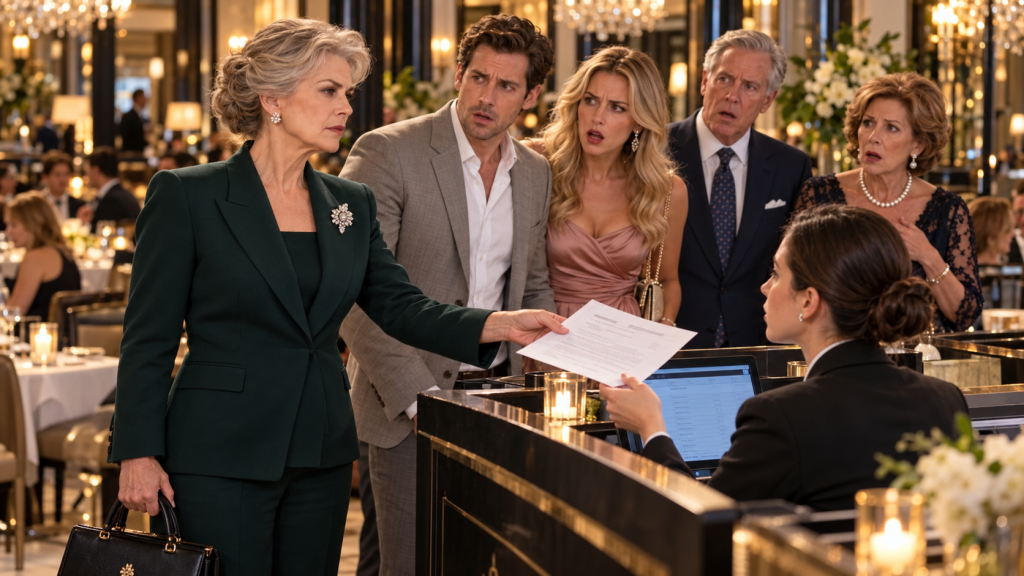
It had become evidence. Adam lowered his voice. “Mom.” I looked at him. “Please.” Vanessa leaned close to him. “Don’t beg.” I almost admired her nerve. Almost. Sofia picked up the telephone behind the desk. “I’m contacting corporate counsel.” Graham frowned. “Over a dinner authorization?”
Sofia looked at him.
“Over a suspected forged authorization attached to a Founder’s Reserve account.”
“It hasn’t even been charged yet.”
“No, sir.”
“And now it won’t be.”
Vanessa folded her arms.
“You’re making this sound criminal.”
I answered before Sofia could.
“Forging someone’s signature usually helps with that.”
Vanessa’s eyes flashed.
Adam stepped between us.
“Mom, it’s my mistake.”
I stared at him.
“My mistake?”
“I shouldn’t have used the form without telling you.”
Without telling me.
Not:
I shouldn’t have forged your name.
Not:
I shouldn’t have tried to spend thirty-eight thousand dollars of your money.
Not:
I shouldn’t have humiliated you on Mother’s Day.
Only:
I shouldn’t have done it without telling you.
The distinction settled something inside me.
For years, I had excused Adam’s selfishness as immaturity.
Then stress.
Then marriage.
Then ambition.
Parents become experts at renaming their adult children’s choices because the original words hurt too much.
Rudeness became exhaustion.
Entitlement became insecurity.
Neglect became being busy.
But standing beneath Bellavita’s amber lights with my forged signature in a plastic sleeve, I finally ran out of softer words.
I said:
“Adam, did you sign my name?”
He looked around.
People were watching.
His in-laws.
The hostess.
Two servers.
A couple waiting for a table.
He hated being watched.
I knew that from childhood.
When he was seven and broke a neighbor’s window, he confessed privately but denied everything in front of other boys.
When he was sixteen and scratched my car, he apologized after midnight so nobody could hear.
My son did not fear wrongdoing nearly as much as humiliation.
He whispered:
“Can we talk somewhere private?”
“No.”
His face hardened.
“Why are you doing this?”
There it was again.
Why are you doing this?
I smiled sadly.
“I asked you a simple question.”
“Did you sign my name?”
Vanessa said:
“Margaret, enough.”
I turned toward her.
“Were you there when he did it?”
Her expression changed.
Only slightly.
But enough.
Graham noticed too.
“Vanessa?”
She looked at her father.
“It’s just a membership document.”
Sofia’s voice remained calm.
“It is not just a membership document.”
She pointed to the heading without touching the sleeve.
“The form purports to authorize third-party charging privileges and private-event use under Mrs. Whitmore’s account.”
Celeste finally spoke.
“Adam told us Margaret had approved the reception.”
I looked at her.
“Did he?”
Vanessa answered:
“She had.”
“Stop.”
Graham looked at his daughter.
Vanessa turned.
“Dad.”
“I said stop.”
His voice had changed.
I did not know Graham Price well.
We had met at holidays.
Weddings.
One stiff anniversary dinner.
He had always struck me as vain rather than foolish.
Now he looked from the forged form to Adam.
Then back to Vanessa.
“You told me this dinner was part of Margaret’s founder benefits.”
Vanessa said:
“It is.”
“No.”
I replied.
“It isn’t.”
Graham’s jaw tightened.
“Then what exactly is this reception?”
Silence.
Adam looked at Vanessa.
Vanessa looked at Graham.
And suddenly I realized something I should have noticed earlier.
There were too many people for a family Mother’s Day dinner.
Six relatives had arrived with them.
But Graham had mentioned a private reception costing thirty-eight thousand dollars.
Thirty-eight guests, perhaps.
Maybe more.
I asked:
“What are you celebrating?”
No one answered.
Then Sofia glanced at the booking screen.
Her face changed.
“Mrs. Whitmore.”
“Yes?”
“There’s a note on the event.”
“What note?”
She hesitated.
“May I print this?”
“Please.”
Adam stepped forward.
“Sofia, don’t.”
Security arrived before he reached the desk.
Two men in dark suits.
Neither touched Adam.
They simply stood between him and Sofia.
That was enough.
Sofia printed the reservation.
One page.
Then another.
Then a third.
She handed the pages to me.
At the top was the event title.
PRICE HOSPITALITY PARTNERS — PRIVATE INVESTOR RECEPTION
Beneath it:
Hosted in association with Margaret Whitmore, Founding Shareholder, Bellavita Group.
I stared.
My name.
Not simply attached to payment.
Attached to endorsement.
My dead husband’s pearl brooch suddenly felt heavy on my lapel.
I looked at Graham.
He had gone pale.
“You didn’t know?”
He shook his head slowly.
“No.”
Vanessa whispered:
“Dad…”
He took the page from me.
I let him.
His eyes moved rapidly.
“Hosted in association with…”
He looked at Adam.
“What is this?”
Adam finally seemed frightened.
“It was supposed to be a launch event.”
“For what?”
“Our new investment group.”
I laughed once.
Not because it was funny.
Because my brain needed another sound to make.
“What investment group?”
Vanessa stepped forward.
“Margaret, it’s not what you think.”
“I have no idea what to think.”
“You never tell us anything about your holdings.”
I stared at her.
“That sentence is fascinating.”
Adam rubbed his forehead.
“Mom, listen.”
“No.”
“You listen.”
I held up the printed proposal.
“You excluded me from Mother’s Day because it was ‘a family occasion.’”
“Then you brought your wife’s family into a restaurant partly owned by me.”
“You forged my signature.”
“You arranged a thirty-eight-thousand-dollar reception.”
“And you advertised me as endorsing an investment business I had never heard of.”
Adam’s face burned.
“When you say it like that—”
“How else should I say it?”
He had no answer.
Then a voice behind me said:
“Margaret.”
I turned.
Antonio Bellini stood near the bar.
Seventy-three years old.
Silver hair.
Charcoal suit.
Still upright enough to make men thirty years younger adjust their posture.
He had founded Bellavita more than three decades earlier.
My husband, Thomas, had believed in him before anyone else did.
Antonio crossed the room and kissed my cheek.
“Happy Mother’s Day.”
I almost laughed at the cruelty of the timing.
“Thank you.”
He looked at Sofia.
“I was told there is a problem.”
Sofia handed him copies.
Antonio read silently.
Then looked at Adam.
“I remember you.”
Adam forced a smile.
“Mr. Bellini.”
“You were twelve the first time you stole tiramisu from my kitchen.”
A few people smiled nervously.
Antonio did not.
“You were more charming then.”
Adam’s face fell.
Antonio turned toward me.
“Corporate counsel is on the way.”
“You don’t need to stay.”
“I know.”
He looked at the authorization.
“I want to.”
Then he read the event proposal.
His jaw tightened.
“Price Hospitality Partners?”
Graham stepped forward.
“Mr. Bellini, I was told Mrs. Whitmore had approved our association.”
Antonio looked at me.
“Did you?”
“No.”
“Then there is no association.”
Simple.
Final.
Graham’s entire posture changed.
He turned toward his daughter.
“What have you done?”
Vanessa’s face twisted.
“Why is everyone acting like I robbed a bank?”
No one answered.
That was when I realized Vanessa still thought the biggest problem was embarrassment.
Just as Adam did.
Maybe that was what had drawn them together.
Not love alone.
A shared belief that consequences were insults inflicted by other people.
Corporate counsel arrived twenty-five minutes later.
Her name was Elena Ward.
She was in her early fifties, dressed in a simple black dress, carrying no briefcase.
She listened.
Read.
Asked questions.
Then said the thing Adam least wanted to hear.
“We will need to preserve all records associated with this reservation.”
He swallowed.
“What records?”
“Emails.”
“Uploads.”
“Account access logs.”
“Event communications.”
“Any documents submitted under Mrs. Whitmore’s name.”
Vanessa said:
“That seems excessive.”
Elena looked at her.
“It is routine when a possible forged authorization is presented.”
Adam lowered his voice.
“Can’t Mom just withdraw the complaint?”
I stared.
“What complaint?”
“The… issue.”
“The issue?”
He looked desperate now.
“You know what I mean.”
“No.”
“I don’t.”
Elena interrupted.
“Mrs. Whitmore has not filed a police complaint through us at this moment.”
Adam exhaled.
Then she continued.
“But the company has its own obligations when false documents are used to access a founder account.”
The relief vanished.
I looked at Elena.
“What happens next?”
“We freeze the event.”
“Preserve records.”
“Disable all third-party access attempts.”
“And review whether anyone has previously contacted Bellavita regarding your ownership or account authority.”
Something in her wording caught me.
“Previously?”
Elena paused.
Antonio looked at her.
“Elena?”
She chose her words carefully.
“There was an inquiry earlier this year.”
My heart slowed.
“What inquiry?”
Adam stopped moving.
That was enough.
I turned toward him.
“What did you do?”
“Mom…”
Elena said:
“Margaret, I would prefer to discuss this privately after we retrieve the file.”
“No.”
I looked at Adam.
“If he knows, I know now.”
Elena hesitated.
Then nodded.
“Approximately four months ago, someone identifying himself as your son contacted investor relations asking about procedures if a shareholder became unable to manage her own affairs.”
The room became silent.
I could hear a spoon strike a plate somewhere behind us.
I looked at Adam.
“You asked about my capacity?”
He stared at the floor.
Vanessa whispered:
“This isn’t the place.”
I turned toward her.
“You seem very concerned about place.”
“Not much about conduct.”
Adam said:
“You had that fall.”
I could not believe him.
“What?”
“You fell in January.”
“In the driveway.”
“On ice.”
“You hit your head.”
“I bruised my elbow.”
“You forgot where you put your medication once.”
I stared.
“I left my vitamins in the bathroom.”
“You called me asking where your tax folder was.”
“Because you had borrowed it.”
That silenced him.
Elena continued carefully.
“The inquiry did not result in any change.”
“Why?”
“Because we require verified legal authority before discussing control of an ownership interest.”
“What did he ask specifically?”
Elena looked at Adam.
Then at me.
“Whether a family member could request redemption of part of your shares if you were incapacitated.”
My mouth went dry.
Antonio swore softly in Italian.
Graham looked physically ill.
I asked:
“How much of my shares?”
“We did not discuss a number.”
Adam spoke quickly.
“I was asking hypothetically.”
Elena looked at him.
“The email later referenced approximately thirty percent of your mother’s position.”
Everything inside me went cold.
I had owned shares in Bellavita Group for thirty-two years.
Not controlling shares.
But meaningful ones.
Thomas and I had invested $110,000 when Antonio’s first restaurant was little more than a beautifully written business plan, two bank rejections, and one impossible dream.
Over the decades, through expansions, restructurings, and retained ownership, my stake had grown substantially.
At the latest internal valuation, it was worth approximately $4.7 million.
Thirty percent of my position would be worth around $1.4 million.
I looked at my son.
He knew.
Of course he knew.
Maybe not the exact valuation.
But enough.
“Why did you need one point four million dollars?”
Adam’s mouth opened.
Closed.
Vanessa said:
“We didn’t.”
I looked at her.
“You’re very quick to answer questions I ask my son.”
Graham suddenly sat down.
Celeste touched his shoulder.
He pulled away.
“What is Price Hospitality Partners?”
I asked again.
Graham looked at me this time.
“My company has been struggling.”
Vanessa snapped:
“Dad.”
He ignored her.
“We expanded too quickly after the pandemic rebound.”
“Two hotel projects stalled.”
“We have debt.”
“How much?”
His jaw tightened.
“About seven hundred thirty thousand dollars in obligations due over the next eight months.”
There it was.
Not thirty-eight thousand.
Seven hundred thirty thousand.
The private reception had never been about Mother’s Day.
It was about investors.
Credibility.
Money.
My name.
Antonio’s restaurant.
Adam’s access.
I looked at Vanessa.
“You were trying to raise capital.”
“Yes.”
“Using my name.”
“We thought you would support family.”
I almost smiled.
“Family.”
That word again.
A door people opened only when they wanted something from me.
Graham looked at his daughter.
“You told me Margaret had already agreed.”
Vanessa’s expression changed.
“Dad, she would have.”
“That is not what I asked.”
Vanessa looked away.
He turned to Adam.
“And you told me your mother wanted to transfer some of her Bellavita interest into a family holding company.”
Adam’s face collapsed.
I stared.
“What family holding company?”
No answer.
Elena closed her eyes briefly.
That told me something else.
“You know about that too?”
She nodded.
“A document was submitted three weeks ago.”
My knees almost weakened.
“What document?”
“A preliminary request to update beneficiary and contact information associated with your shareholder file.”
“Did you process it?”
“No.”
“Why?”
“The signature was inconsistent with our records, and the banking information did not match.”
Banking information.
I looked at Adam.
“Whose account?”
Elena answered.
“The form referenced an entity called Whitmore Family Holdings LLC.”
I had never heard of it.
Graham stood.
“Jesus Christ.”
Vanessa whispered:
“Dad, stop.”
“No.”
He turned on her.
“You told me Margaret created that company.”
Vanessa said nothing.
He looked at me.
“I swear to you, I thought you were involved.”
Did I believe him?
Not completely.
But I believed he had just realized he might have built a financial pitch around a lie.
Adam tried again.
“Mom, it was supposed to be for estate planning.”
I stared at him.
“You created a company with my name in it?”
“You always said you wanted things to stay in the family.”
“I said I wanted my grandmother’s china to stay in the family.”
“That is not the same as transferring millions of dollars.”
Vanessa’s face hardened.
“You were going to leave it to Adam eventually.”
That sentence ended whatever softness remained in me toward her.
I stepped closer.
“No.”
She blinked.
“What?”
“You do not get to inherit me while I’m still alive.”
Even Antonio looked away after that.
Maybe to hide emotion.
Maybe because he had known Thomas.
Maybe because he understood exactly what I meant.
Elena suggested we move to a private room.
This time, I agreed.
Not to protect Adam from embarrassment.
Because I needed to think.
Security escorted Adam, Vanessa, Graham, and Celeste to a separate lounge while counsel preserved the event materials.
The other guests were told the private reception had been canceled.
Some left.
Some pretended not to stare.
I sat in Antonio’s office with Elena and Sofia.
Antonio poured me water.
Not wine.
He knew me well.
For several minutes, no one spoke.
Then Elena said:
“Margaret, I recommend you contact your personal attorney.”
“I will.”
“And your bank.”
“Yes.”
“We should also discuss whether you want to make a police report concerning the forged authorization presented today.”
I stared at the wall.
There was a framed photograph of Thomas and me from Bellavita’s tenth anniversary.
I had forgotten it was there.
Thomas looked forty-eight.
I was forty-five.
Adam was thirteen then.
He had spent most of that dinner stealing breadsticks and asking Antonio if restaurants ever closed.
I looked at the photograph until my eyes blurred.
“My son forged my signature.”
Nobody answered.
I whispered:
“I keep waiting for someone to tell me I misunderstood.”
Antonio sat beside me.
“You did not.”
That hurt.
The truth often does.
I called my attorney, Evelyn Hart, from Antonio’s office.
She had handled our estate plan for years.
When I told her what happened, she became silent.
Then:
“Margaret, do not sign anything.”
“I’m not planning to.”
“Do not agree to any family meeting without counsel.”
“I’m sitting in one of my own restaurants with corporate counsel.”
A pause.
“One of your restaurants?”
I smiled despite myself.
“Long story.”
Evelyn arrived an hour later.
She reviewed everything.
Then asked a question nobody else had.
“Adam, Vanessa, or both—who has had access to your home office?”
I froze.
Adam had a key to my house.
Of course he did.
He was my son.
After Thomas died, I gave him one.
For emergencies.
For checking the furnace when I traveled.
For feeding my cat before she died.
“He does.”
“Does Vanessa?”
“Through him.”
“What documents are in the office?”
“Tax returns.”
“Old partnership statements.”
“Estate papers.”
“Copies of my signature.”
Evelyn closed her eyes.
“Margaret.”
“I know.”
“No.”
“You trusted your son.”
“This is not the moment to prosecute yourself.”
That sentence stayed with me.
By seven that evening, I filed a police report.
Not because I wanted Adam arrested at dinner.
He wasn’t.
There was no dramatic handcuffing beside the tiramisu.
The officers took information.
Accepted copies.
Told us investigators would follow up.
The restaurant canceled the reception.
The forged document was preserved.
Corporate access was frozen.
My bank accounts were flagged for additional verification.
My home locks were changed the next morning.
And at 9:14 p.m. on Mother’s Day, after the restaurant had mostly emptied, I sat at the same table where I had eaten dinner alone.
Antonio placed a slice of lemon cake in front of me.
“I didn’t order this.”
“No.”
“Then why is it here?”
“Because your husband hated lemon cake.”
I looked at him.
Antonio smiled.
“And you loved it.”
I started crying.
Not because of the cake.
Because Thomas was dead.
Because Adam was alive.
And somehow I had lost both of them in different ways.
Antonio sat across from me.
“Thomas would be furious.”
I laughed through tears.
“At Adam?”
“At you.”
I stared.
“For what?”
“For blaming yourself already.”
I looked down.
He knew me too well.
The next forty-eight hours were worse.
Because shock is almost merciful.
It lets the mind move slowly.
Then paperwork arrives.
Emails.
Statements.
Dates.
Evidence turns betrayal into chronology.
Bellavita’s review found five contacts from Adam over six months.
The first was casual.
Questions about founder membership.
Then investor-relations procedures.
Then capacity.
Then succession.
Then the document involving Whitmore Family Holdings.
None had changed my legal ownership.
Nothing had been transferred.
That mattered.
The system had worked.
Slowly.
Quietly.
But it had worked.
Then Evelyn called.
“There’s more.”
I sat at my kitchen table.
“Of course there is.”
“Whitmore Family Holdings was formed five months ago.”
“By whom?”
“Adam and Vanessa.”
My stomach turned.
“Ownership?”
“Fifty-fifty.”
I laughed.
A bitter little sound.
“My family holding company.”
“Yes.”
“With no family in it except them.”
“Yes.”
“What was it for?”
“We’re still finding out.”
We found out.
Price Hospitality Partners needed money.
Not only seven hundred thirty thousand.
That was near-term debt.
The business had total liabilities approaching $1.3 million.
Graham had personally guaranteed part of it.
Vanessa was terrified her parents would lose their home and business.
Adam was terrified Vanessa would blame him for not helping.
That sentence came from his own later testimony.
Not mine.
Adam had always wanted to be admired.
As a boy.
As a husband.
As a son.
He could survive disappointment.
He could not survive feeling small.
Vanessa knew that.
She told him my Bellavita stake would someday be his anyway.
He told himself that using part of it now was different from stealing.
There are lies we tell other people.
And lies designed for mirrors.
Adam became very good at the second kind.
Investigators recovered emails and messages.
No dramatic hacker.
No secret spy.
Legal process.
Devices.
Accounts.
Voluntary productions.
One message from Vanessa said:
Your mother is sitting on millions while my parents are drowning. What exactly is family for?
Adam replied:
I’ll talk to her.
Two days later:
She’ll say no if she knows the amount.
Vanessa:
Then don’t make it about the amount. Make it about estate planning.
Another message, weeks later:
Did you get the signature handled?
Adam:
Yes.
I stopped reading after that.
Evelyn told me:
“You do not need to read every message.”
I said:
“I raised him.”
She answered:
“That does not mean you need to read every thought he had while betraying you.”
I closed the file.
The darkest part was not that Vanessa manipulated him.
She did.
The messages made that clear.
But Adam participated.
Enthusiastically sometimes.
That mattered.
He was forty-one years old.
I would not infantilize him because the alternative hurt me.
The $38,000 reception had a specific purpose.
Graham’s company was seeking outside investment.
The event was designed to impress twelve prospective investors and several local business contacts.
My name appeared on the invitation as a “founding hospitality investor.”
My Bellavita association made it seem I endorsed the Price family’s new venture.
I had never seen the invitation.
One investor later told investigators:
“I only agreed to attend because Margaret Whitmore’s name was on it.”
That sentence made me furious.
My reputation.
Thomas’s reputation.
Antonio’s.
All used as decorations on someone else’s desperation.
Graham hired his own attorney.
Then did something that surprised me.
He cooperated.
Fully.
He turned over emails.
Event proposals.
Texts.
Financial projections.
He had believed I was involved.
But not innocently in every respect.
He admitted he never personally called me to confirm.
Why?
Because Vanessa told him I was “old-fashioned” and disliked talking business with in-laws.
He accepted the explanation because it benefited him.
Comfort again.
Convenience again.
The same disease in different clothing.
Celeste called me two weeks later.
I almost did not answer.
“Margaret.”
“What?”
Her voice broke.
“I owe you an apology.”
I waited.
“For the restaurant.”
“Yes.”
“I was cruel.”
“Yes.”
She inhaled sharply.
“I thought you had chosen not to come.”
I stared out my window.
“You still called me depressing.”
“I know.”
“You said some mothers can’t let go.”
“I know.”
Silence.
Then:
“I was performing.”
“What does that mean?”
She whispered:
“I wanted Vanessa to think I was on her side.”
I laughed sadly.
“That family seems to do a lot of performing.”
She did not disagree.
I did not forgive Celeste that day.
But at least she apologized without asking me to comfort her.
Vanessa never did.
Not then.
The civil side became complicated.
Bellavita Group had incurred legal and compliance costs.
The proposed reception had vendors.
The entity formation involved misrepresentations but no successful transfer of my shares.
My personal financial loss was limited because the scheme was stopped before money moved.
That was fortunate.
It also meant some people said:
“But you didn’t actually lose anything.”
I stopped speaking to those people.
Attempted betrayal does not become harmless because somebody catches the hand before it reaches the wallet.
The criminal investigation focused on forged documents, attempted financial fraud, and related conduct.
I will not pretend every count survived exactly as first imagined.
They did not.
Cases change.
Prosecutors choose what they can prove.
Some allegations were treated as evidence of intent rather than separate charges.
Months passed.
Then a year.
Adam and Vanessa’s marriage began collapsing before the first major hearing.
Each blamed the other.
Vanessa said Adam forged the documents.
Adam said Vanessa designed the plan.
Both were partly right.
That is what made it uglier.
Graham’s company entered restructuring.
He sold one property.
Reduced staff.
Avoided bankruptcy.
Barely.
The investor reception never happened.
My name disappeared from every Price Hospitality document.
Antonio made sure of that.
Bellavita also conducted an internal security review.
Not because its system had failed.
Because Elena said:
“If someone comes this close, we learn anyway.”
I admired that.
They added direct shareholder verification for any family-authority request.
Capacity-related inquiries triggered immediate contact with the shareholder unless legally prohibited.
Founder memberships no longer accepted third-party event authorization without enhanced verification.
Antonio joked:
“Your son improved our compliance system.”
I stared at him.
“Do not try to find silver linings today.”
He raised both hands.
“Understood.”
My relationship with Adam went silent.
For eleven months.
Not because he did not try.
He emailed.
Called through attorneys.
Sent letters.
At first, every letter contained the same sentence in different forms.
Vanessa pressured me.
I was trying to help her parents.
I never intended for you to lose anything.
I thought it would stay in the family.
Every sentence was built around intent.
None around choice.
Then, eleven months after Mother’s Day, a new letter came.
One page.
No excuses.
Mom, I forged your name.
I stopped.
Read it again.
I used the fact that you trusted me to access information I had no right to use.
I told myself I was borrowing from an inheritance I expected someday. That was grotesque. You were alive, competent, and entitled to every decision about your money.
My eyes filled.
Then:
Vanessa wanted it. I wanted to be the man who could provide it. I chose to betray you rather than disappoint her. That is mine.
For the first time, he sounded like my son.
Not because he apologized.
Because he stopped hiding behind grammar.
I did not respond.
Not yet.
The plea negotiations began several months later.
Vanessa eventually entered a plea related to the fraudulent scheme and document use.
Her sentence included a short custodial term, probation, financial penalties, and restitution for certain costs.
Adam’s involvement was broader.
He had created the entity.
Submitted documents.
Presented the forged restaurant authorization.
He pleaded guilty to multiple fraud- and forgery-related offenses.
The judge imposed a sentence that included twenty-eight months in custody, followed by supervised release and financial obligations.
Some people thought it was too little.
Some thought too much because no million-dollar transfer succeeded.
I stopped measuring.
The number of months did not restore Mother’s Day.
It did not restore trust.
It did something law is supposed to do.
Marked the conduct as real.
At sentencing, I was permitted to speak.
I almost declined.
Then I remembered Adam at Bellavita saying:
“Mom, you wouldn’t do this to me.”
So I went.
I wore the same navy suit.
The same pearl brooch.
Not deliberately at first.
Then deliberately.
Adam saw it.
His face changed.
I read from two pages.
“When my son was a child, I taught him that taking something without permission was wrong.”
“When he became a man, I assumed the lesson had become part of him.”
“I was wrong.”
Adam looked down.
I continued.
“The money matters.”
“The forged signature matters.”
“The attempted use of my ownership interest matters.”
“But what I struggle with most is simpler.”
“You needed me to become incompetent in the story you were telling other people.”
The courtroom went silent.
“You described me as forgetful.”
“Confused.”
“Unable to understand financial arrangements.”
“You turned normal aging into a tool because my competence stood between you and what you wanted.”
My voice broke.
I stopped.
Then continued.
“I can survive losing money.”
“I can survive embarrassment.”
“I do not know whether our relationship can survive the fact that my own son found it useful to make me smaller.”
Adam started crying.
I did not stop.
“I love you.”
“That is true.”
“I am angry with you.”
“That is also true.”
“I hope prison is not the most important consequence of what you did.”
“I hope the most important consequence is that you eventually become a man who no longer needs another person to be weak so you can feel powerful.”
Then I sat down.
Adam did not look at me again.
Vanessa and Adam divorced while he was incarcerated.
No dramatic courtroom screaming.
No final slap.
Lawyers.
Paper.
Property division.
Debts.
The end of a marriage that had once convinced itself entitlement was loyalty.
Graham sent me a letter after the divorce.
He wrote:
I blamed Adam because it was easier than admitting my daughter learned some of her worst ideas about money from me.
I respected that sentence.
He admitted he had raised Vanessa to believe financial success protected a family from humiliation.
When his company began failing, she treated the failure like shame instead of information.
He had done the same.
He wrote:
I should have called you before attaching your name to anything. I did not because I wanted the story I was being told to be true.
Comfort again.
At least he finally named it.
I never became friends with Graham and Celeste.
But the hostility ended.
Sometimes that is enough.
My relationship with Bellavita changed too.
For years, I had been a quiet investor.
Thomas enjoyed the business side.
I enjoyed the food.
After his death, I let professionals manage most matters and collected distributions.
Adam apparently interpreted my quietness as ignorance.
That offended me enough to become interested again.
At sixty-nine, I started attending quarterly shareholder meetings more regularly.
Antonio teased me.
“You finally read the packets?”
“I always read the packets.”
“You used to doodle in the margins.”
“That was analysis.”
I joined a governance committee for two years.
Not because I needed power.
Because I remembered who I had been before widowhood.
Before I became “Adam’s mother.”
Before Vanessa became “family.”
I had studied accounting for two years before switching careers.
I had helped Thomas evaluate Antonio’s original proposal.
I had written the first check.
That history belonged to me too.
The Bellavita stake later valued around $5.2 million.
I did not sell it.
Not out of spite.
Because I liked owning it.
That was reason enough.
Evelyn and I rewrote my estate plan.
Adam was not disinherited completely.
That surprised everyone.
Especially him.
I created specific bequests.
Education funds for future grandchildren.
Charitable gifts.
A substantial portion to a foundation supporting older adults facing financial exploitation.
Bellavita shares would partly pass into a trust and partly be offered back to the company under an existing shareholder agreement.
Adam’s inheritance became a fixed amount.
Not millions.
Not nothing.
Evelyn asked:
“Are you sure?”
“Yes.”
“Why not cut him out?”
“Because estate planning is not sentencing.”
She smiled.
“That is the healthiest thing you’ve said all month.”
“Don’t get used to it.”
Three years after Mother’s Day, Adam came home from custody.
Not to my house.
To a small apartment.
He found work with a distribution company.
Not glamorous.
Good.
He started therapy while incarcerated and continued afterward.
I knew because he told me.
I did not praise him for it.
Therapy is not a medal.
It is work.
Six months after his release, he asked if I would meet him for coffee.
I waited three days before answering.
One hour. Public place.
He replied:
Thank you.
We met at a quiet café.
Not Bellavita.
He looked older.
Not dramatically.
Just thinner around the face.
No expensive watch.
No polished confidence.
He stood when I entered.
“Mom.”
“Adam.”
We sat.
He did not reach for me.
Good.
For five minutes, neither spoke.
Then he said:
“I don’t expect forgiveness.”
I almost smiled.
“Good start.”
He nodded.
“I spent the first six months after sentencing believing Vanessa ruined my life.”
I said nothing.
“Then I spent another six months believing her family used me.”
Still nothing.
“Then my counselor asked me why I needed so badly for someone else to be the main character in what I did.”
That was a good counselor.
Adam looked down.
“I forged your name.”
“Yes.”
“I tried to use your shares.”
“Yes.”
“I told people you were losing capacity.”
“Yes.”
His voice broke.
“I don’t know how I became that man.”
I studied him.
“You became him one decision at a time.”
He looked up.
That hurt him.
Good.
Not cruelly.
But truth should have weight.
He nodded.
“I think so.”
Then:
“Do you hate me?”
I thought about it.
“No.”
He started crying.
I continued.
“That is not the same as trusting you.”
“I know.”
“Do you?”
“I’m learning.”
He wiped his face.
“I miss you.”
I looked out the window.
“I miss who I thought you were.”
He nodded.
“I understand.”
“No.”
“You understand the sentence.”
“Understanding it will take longer.”
Fair.
We drank coffee.
One hour.
Then I left.
No hug.
Not yet.
A year later, we met again.
Then again.
No money discussions.
No requests.
No estate questions.
No guilt.
Adam began volunteering with a financial-literacy program connected to reentry services.
The first time he told me, I almost laughed.
“That is bold.”
He smiled weakly.
“I know.”
“What do you teach?”
“Mostly budgeting.”
“Not forgery prevention?”
“Mom.”
I smiled.
That was the first time we joked together after everything.
It felt strange.
Good.
Painful.
Human.
Vanessa’s life went another direction.
She moved to Florida after probation.
Worked in luxury real estate.
Remarried years later.
I heard through Celeste.
I did not investigate.
Not every person who hurts you needs to remain a project.
I hoped she changed.
I did not need evidence.
Graham eventually sold Price Hospitality Partners.
Not for enough to erase every debt.
Enough to retire modestly.
He once invited me to lunch to apologize in person.
I accepted.
He said:
“I used to think losing money was the worst thing that could happen to a family.”
“What changed?”
“My daughter nearly went to prison longer than she did.”
I looked at him.
“That’ll adjust a spreadsheet.”
He laughed.
We understood each other better by then.
Not friends.
Survivors of our adult children’s choices.
There is a strange fraternity in that.
The fifth Mother’s Day after the restaurant incident, I returned to Bellavita.
Alone.
On purpose.
Same navy suit?
No.
I wore red.
Antonio’s son, Marco, was running day-to-day operations by then.
Antonio was mostly retired but appeared whenever free food and attention were available.
Sofia had become general manager.
When she saw me, she smiled.
“Table for one?”
I smiled back.
“Table for one.”
No pity.
No sadness.
I sat by the window.
Ordered pasta.
Ate slowly.
Around me, families celebrated.
Children brought flowers.
Grandmothers complained about noise.
A toddler threw bread.
Life.
Halfway through dinner, Sofia approached.
“There’s something at the desk.”
I frowned.
“What?”
“Not a bill.”
I followed her.
One envelope.
My name.
No forged signature.
Inside was a Mother’s Day card.
From Adam.
Mom,
I wanted to come, but I remembered that asking what you wanted matters more than creating a scene about what I want.
Happy Mother’s Day.
I love you.
Adam
No request.
No apology performance.
No money.
I read it twice.
Then called him.
He answered immediately.
“Mom?”
“Where are you?”
“At home.”
“Have you eaten?”
A pause.
“No.”
I looked at Sofia.
She smiled.
I said:
“If you can be here in thirty minutes, I’ll order you something.”
Adam went silent.
Then:
“Are you sure?”
“Yes.”
“Can I bring flowers?”
I thought of the restaurant five years earlier.
My empty table.
His forged paper.
His wife laughing.
Thirty-eight thousand dollars.
One point four million.
Court.
Prison.
Coffee.
Time.
“No.”
He laughed softly.
“Okay.”
“Bring yourself.”
He arrived twenty-six minutes later.
No flowers.
No gift.
No Vanessa.
No performance.
He stopped beside the table.
“Can I sit?”
I nodded.
He sat.
For a while, we ate.
Not repaired.
Not erased.
Not restored to what we had been.
Something different.
At one point, Adam glanced around the restaurant.
“I still can’t believe you own part of this place.”
I smiled.
“You knew.”
“I knew Dad invested.”
“You knew enough to try stealing part of it.”
He winced.
“Fair.”
I almost apologized.
Old reflex.
I did not.
Truth did not require cushioning.
Then he smiled.
“Antonio still hates me?”
“Antonio hates bad risotto.”
“You are lower priority.”
“Comforting.”
We laughed.
That was the first Mother’s Day in years I went home without crying.
Not because Adam had earned complete forgiveness.
Because I had finally stopped requiring one perfect ending.
Years passed.
Antonio died at eighty-four.
Bellavita closed the flagship restaurant for one afternoon for his memorial.
I spoke.
So did chefs.
Servers.
Investors.
Dishwashers.
People who had known him before his hair turned white.
I told the story of Thomas writing that first $110,000 check.
Not Adam’s story.
Antonio deserved his own day.
Afterward, Adam stood beside me.
“You and Dad really risked that much on one restaurant?”
“Yes.”
“That was reckless.”
“Very.”
“And it worked.”
“Mostly.”
He looked at me.
“You trusted people.”
“Yes.”
“After everything, do you still?”
I thought.
“Trust is not the absence of verification.”
He smiled.
“That sounds like corporate compliance.”
“I have become unbearable.”
“You always were.”
I nudged him.
Some relationships come back by millimeters.
That was ours.
When I turned seventy-eight, Adam gave me a small wooden box.
Inside was my old pearl brooch.
I stared.
“I already own this.”
“You left it at my apartment after dinner last year.”
“I did?”
“Yes.”
I froze.
Then narrowed my eyes.
“Do not make a capacity joke.”
Adam burst out laughing.
I did too.
Ten years earlier, a forgotten object would have terrified me.
Because he had used ordinary aging against me.
Now we could laugh because he had spent years proving he understood the line.
At eighty, I stepped back from Bellavita governance.
Still owned my stake.
Still read reports.
Still corrected younger executives when they tried to explain things too slowly.
Marco once said:
“Margaret, you’re terrifying.”
“Your father said the same.”
“No.”
“He said worse.”
I created the Thomas and Margaret Whitmore Fellowship for restaurant employees pursuing business, culinary, or hospitality education.
Not because I had become sentimental.
Because Thomas believed businesses should create people, not just profit.
At the first fellowship dinner, a young server named Ana received tuition support.
She hugged me.
I hated public hugging.
Allowed it.
Adam attended.
He sat in the back.
Did not tell anyone he was my son until asked.
That mattered.
He had finally learned not to use my name as currency.
At eighty-two, I updated my will one final time.
Adam received more than the fixed amount I had once planned.
Not because he had demanded it.
He had never asked again.
Because trust had regrown enough that I wanted to.
Not the entire Bellavita stake.
Never assumed inheritance.
But something meaningful.
Evelyn had retired by then.
Her daughter handled the documents.
She asked:
“What changed?”
I said:
“He did.”
That was enough.
Celeste died before Graham.
Vanessa came to the funeral.
I saw her across the room.
Older.
Blonde hair shorter.
Different husband beside her.
She approached.
I braced myself.
“Margaret.”
“Vanessa.”
She looked nervous.
“I owe you an apology.”
I almost laughed.
“Fifteen years late.”
“I know.”
She swallowed.
“I was awful to you before the money.”
Good.
She understood.
Not just fraud.
Cruelty.
“I treated you like being older made you disposable.”
I stayed silent.
She continued.
“I think I needed you to be pathetic because your independence made me uncomfortable.”
That was more insight than I expected.
“I was used to my parents measuring love through money.”
“When Adam told me how much you owned, I stopped seeing you as his mother and started seeing a resource.”
Her eyes filled.
“I am ashamed of that.”
I believed her.
I did not invite her into my life.
But I said:
“Thank you for saying it.”
She nodded.
Then left.
That was enough.
Graham died three years later.
Adam attended the funeral.
I did not.
Not out of anger.
The relationship simply did not require it.
At eighty-six, I finally sold half my Bellavita position back to the company.
The amount was substantial.
I gave some away.
Kept plenty.
Paid taxes.
Ignored everyone who told me how to optimize.
I bought nothing extravagant.
Except one thing.
A small cottage on Cape Cod.
Thomas and I had once talked about it.
Never did it.
I bought one with a porch facing the water.
Adam helped me move furniture.
At one point, he held up an old framed photo.
Me.
Thomas.
Adam at ten.
“Keep?”
I looked at it.
“Yes.”
He hesitated.
“You don’t hate that version of me?”
I stared.
“You were ten.”
He smiled.
“Good point.”
I took the photograph.
“You were not born on Mother’s Day at Bellavita, Adam.”
“You had forty-one years before that.”
“You made terrible choices.”
“They matter.”
“They are not the only choices you ever made.”
His eyes filled.
“Thank you.”
“Don’t get dramatic.”
“Too late.”
We put the photograph on the mantel.
When I was eighty-eight, Adam became a grandfather.
His daughter from an earlier relationship, Megan, had a baby girl.
Yes.
There had always been another part of the family barely touched by Vanessa’s drama.
Megan had been twenty-two during the Bellavita scandal and living across the country.
She had loved her father but refused to defend him.
I respected her for that.
She named her daughter Thomasina Margaret Reed.
I objected immediately.
“That child is going to hate you.”
Megan laughed.
“We’ll call her Tommy.”
“Worse.”
Adam cried when he held the baby.
I watched him.
For years, I had thought the greatest tragedy was that my son tried to steal from me.
Later I understood the greater danger would have been letting that act become the only story I ever told about him.
Accountability does not require flattening people.
Adam had committed fraud.
Served time.
Lost his marriage.
Lost my trust.
Then spent decades becoming someone more honest.
Both parts mattered.
At ninety, I stopped driving.
Not because I was incompetent.
Because night vision had become terrible and Boston drivers had not improved.
Adam took me to Bellavita one Sunday.
Mother’s Day.
Again.
He parked.
Came around to open my door.
I said:
“I can do that.”
“I know.”
“Then why are you doing it?”
“Because I’m trying to be polite.”
“Suspicious.”
He laughed.
Inside, Sofia’s daughter was managing the front desk.
That made me feel approximately four hundred years old.
Our membership number still existed.
The young hostess typed it.
Then looked up.
“Wow.”
Adam leaned toward her.
“What?”
She smiled.
“One of the oldest active accounts.”
I looked at Adam.
He looked at me.
Then we both started laughing.
The hostess did not know why.
Good.
Some jokes belong to the people who survived them.
At dinner, Adam raised his glass.
“To Mom.”
I narrowed my eyes.
“That better be all.”
“That’s all.”
“No inheritance jokes.”
“No.”
“No shareholder jokes.”
“No.”
“No thirty-eight-thousand-dollar receptions.”
He covered his face.
“It’s been twenty years.”
“I have an excellent memory.”
He looked at me.
We both stopped.
Then laughed even harder.
Memory.
The word he had once tried to turn against me.
Now ours again.
That night, back at the cottage, I sat on the porch and thought about the first Mother’s Day at Bellavita.
The empty chair.
Vanessa’s laugh.
Adam reading out my membership number.
The forged signature.
Sofia’s expression.
My own hand reaching for the paper.
People often tell the story as if my power came from being an investor.
As if the satisfying part was that Vanessa thought I was a lonely old widow and discovered I owned millions.
I understand why people like that version.
It has symmetry.
Humiliation reversed.
But I have lived long enough to dislike it.
Because if I had owned nothing, what Adam did would still have been wrong.
If I had been confused about investments, he still had no right to forge my signature.
If I had been poor, Vanessa still had no right to mock me for eating alone.
If I had not helped finance Bellavita thirty-two years earlier, I still deserved dignity.
My ownership made the reveal dramatic.
It did not create my worth.
That distinction became important to me.
Especially as I grew older.
Older people are often treated as if competence is something they must constantly prove.
One forgotten name.
One misplaced key.
One slower step.
And suddenly somebody younger wants to stand between you and your own decisions.
Sometimes intervention is necessary.
Sometimes people truly need help.
But help without respect can become control very quickly.
Adam learned that in the hardest possible way.
So did I.
On the last Mother’s Day I remember clearly, I was ninety-two.
Adam was sixty-five.
He came to the cottage carrying no flowers.
Good.
He brought lemon cake.
Better.
We sat on the porch.
The ocean looked silver.
He cut two slices.
Then said:
“Mom?”
“Yes?”
“I’ve wondered about something for years.”
“What?”
“If you hadn’t heard me reading the membership number…”
I looked at him.
He swallowed.
“Would I have gone through with the share transfer?”
I did not answer immediately.
“You tell me.”
He stared at the water.
“Yes.”
I appreciated that.
Not:
Maybe.
Not:
Vanessa would have stopped me.
Yes.
Then he said:
“That’s the part I’m most ashamed of.”
I nodded.
“It should be.”
He laughed softly.
“You never make these moments easy.”
“No.”
“Why start now?”
He handed me cake.
After a while, I said:
“You know what I’m proudest of?”
He looked surprised.
“What?”
“That you stopped needing me to say you were a good person.”
He went quiet.
“For years after prison, every apology had a question hidden inside it.”
Am I good again?
Do you forgive me?
Can you tell me I’m not like that anymore?
“You wanted me to give you your identity back.”
He nodded slowly.
“Eventually you built one.”
His eyes filled.
“That took a while.”
“Yes.”
“So did my trust.”
He smiled.
“Fair.”
We sat there until sunset.
No dramatic reconciliation.
No perfect family portrait.
Just two old people eating lemon cake.
A mother.
A son.
Both knowing exactly what happened.
Neither pretending it didn’t.
That was enough.
When I think back to the moment Sofia said:
“Mrs. Whitmore, would you also like me to notify Mr. Bellini?”
I remember Vanessa laughing.
Why would the owner care?
There are questions that accidentally expose entire lives.
Why would the owner care?
Because I was not the helpless old woman she had decided I was.
But even that is not the answer I would give now.
Why did it matter?
Because somebody forged my name.
My signature was not decoration.
My money was not family property.
My age was not permission.
My silence was not consent.
And motherhood was not a lifetime contract requiring me to protect my child from consequences he had knowingly earned.
That was the lesson I learned at sixty-eight.
A mother can love her son and still call the police.
A mother can hope for his recovery and still testify truthfully.
A mother can forgive without restoring access overnight.
A mother can leave an empty chair empty until the person who wants to sit there learns how to ask.
And an older woman eating alone on Mother’s Day is not necessarily lonely.
Sometimes she is simply waiting to remember that she belongs to herself.
That night at Bellavita, my son believed the most powerful thing I possessed was membership number 000147.
He was wrong.
It was my name.
Margaret Whitmore.
And once I stopped letting other people decide what that name was worth, nobody ever spent it for me again.